
Decomposition and Odor: An Honest Guide
Decomposition and Odor: An Honest Guide
After an unattended death, two questions dominate: how long has this been happening, and will the smell ever go away? Below are honest timelines, what the odor actually means, and the line between what you can handle and what requires professionals.
- Odor typically becomes noticeable within 24–72 hours and intensifies through the first week, depending on temperature.
- The smell alone tells you little about safety — but it tells you a lot about how far contamination has spread.
- Ozone machines and odor bombs treat air, not sources. If the smell returns after treatment, the source is still there.
- Porous materials (mattresses, carpet padding, drywall, insulation) usually must be removed, not cleaned.
Nobody writes this guide for fun — people find it because something happened and they need straight answers. This page stays clinical and practical: what the timeline looks like, what the odor means, what actually removes it, and where the honest line sits between a DIY cleanup and calling professionals.
What the timeline looks like
Decomposition follows a predictable sequence, and the timeline is driven mostly by temperature: warmth accelerates everything, cold slows it. In the first day or two, changes are internal and odor is minimal. Bloating typically begins around day 3–4. Active decay — when odor is strongest — runs roughly days 5–10. Advanced decay follows over the next week or two, and skeletonization takes weeks to months depending on conditions.
One detail almost no consumer guide mentions: forensic researchers using gas chromatography have shown that the odor’s chemical mix shifts as decomposition moves through its stages — sulfur compounds dominate the early days, then ketones, nitrogen compounds, and acids take over. The smell doesn’t just get stronger; it changes character. That is why “it smelled fine yesterday” means very little.
What the odor means (and doesn’t)
The smell comes from a cocktail of gases — putrescine, cadaverine, skatole, hydrogen sulfide among them — released as tissues break down. It is often described as sweet, rotten, and chemical all at once, and it clings to fabrics, drywall, and anything porous nearby.
Two things the odor does and doesn’t tell you. It does indicate how far contamination has traveled: a faint smell in one room is a different job than a smell that hits you in the hallway. It doesn’t reliably indicate disease risk — odor intensity and pathogen presence are different problems, handled with different precautions. Treat the smell as a contamination map, not a danger meter.
What actually removes it: the honest boundary
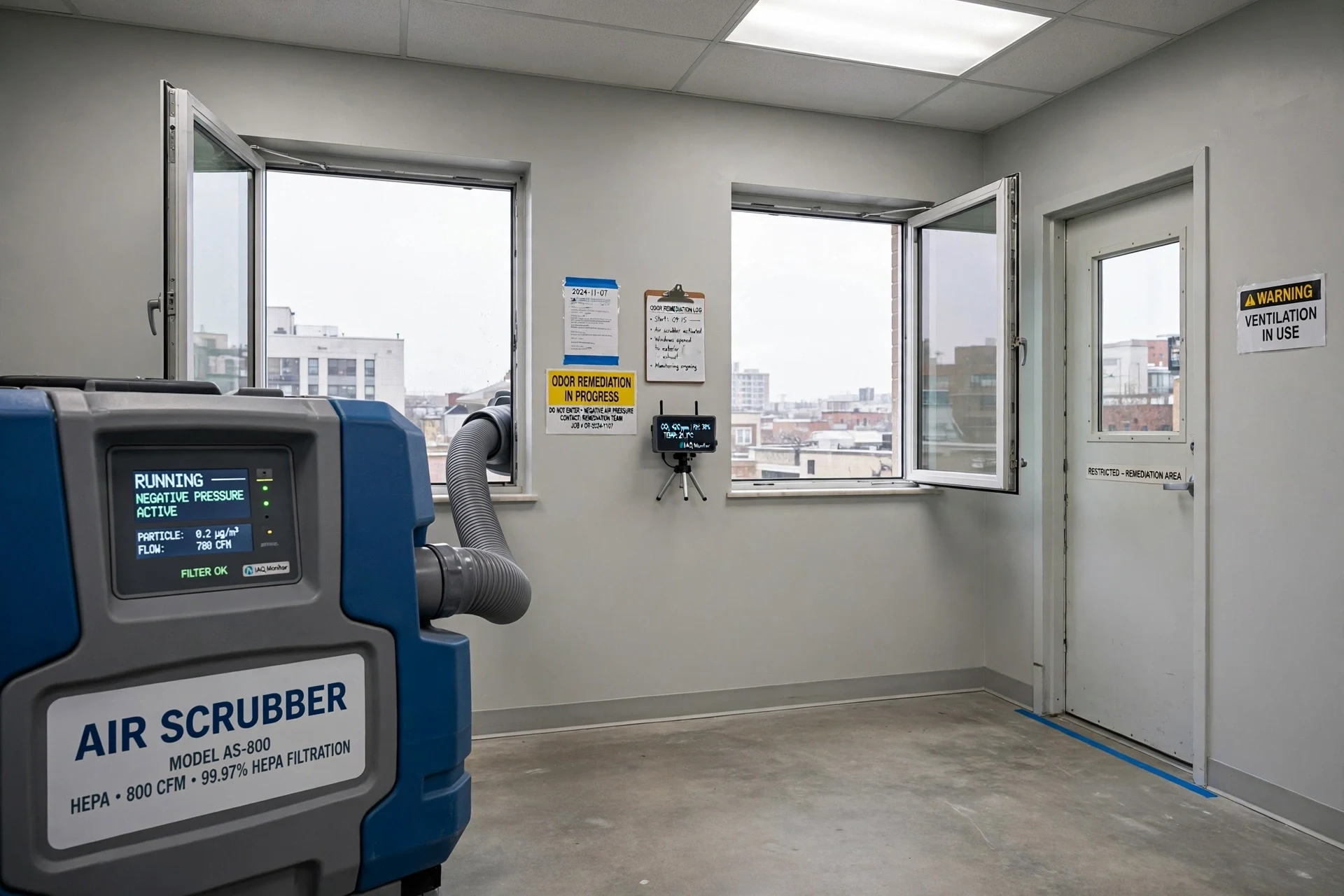
Here is the line every cleanup company’s website avoids drawing. DIY can work when contamination is limited to hard, non-porous surfaces: sealed tile, glass, metal, finished wood that wiped clean. Ventilation, HEPA air scrubbers, and enzymatic cleaners have real uses at this end of the spectrum.
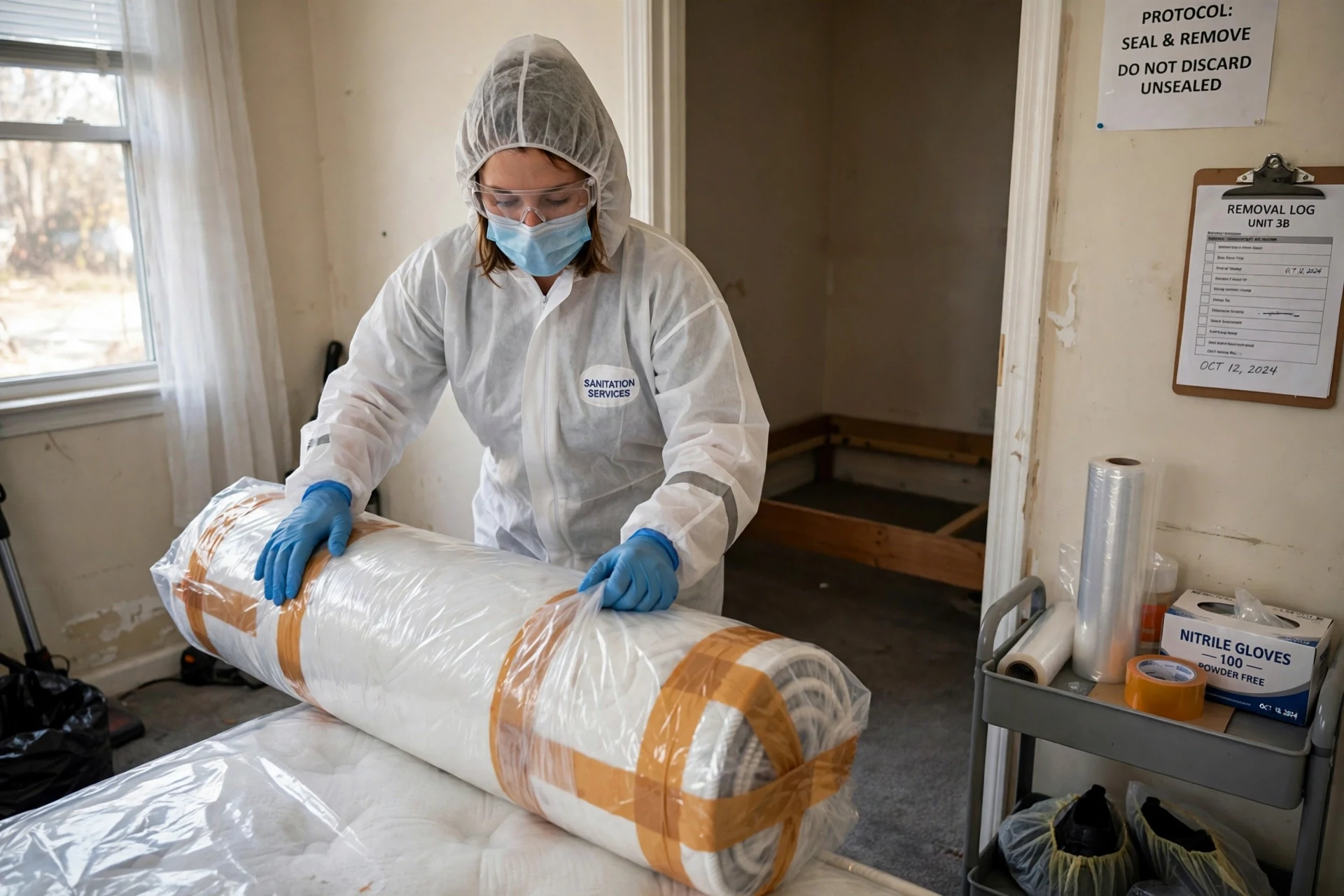
DIY cannot work when fluids or odor have penetrated porous materials. A mattress that absorbed decomposition fluids cannot be cleaned — it must be removed and disposed of as regulated waste. The same applies to carpet padding, and often to the bottom inches of drywall and insulation near the source. No ozone treatment, fogger, or enzyme spray reverses absorption; at best they mask it until the masking fades. If a “treatment” made the smell vanish for a week and it came back, that is your answer: the source is still in the structure.
Every guide in this cluster
Four guides, each going deep on one piece. They link to each other — follow the one that matches your situation.
Decomposition timeline
The five stages in plain clinical language: what happens in the first 48 hours, when odor peaks, and what the timeline means for cleanup — including how the odor’s chemistry shifts between stages.
Removing decomposition odor
The honest DIY-vs-professional boundary: when ventilation and enzymatic treatment are enough, when materials must be removed, and why ozone can’t replace source removal.
What it smells like
A clinical, non-graphic explanation of decomposition odor — the compounds involved, how far it travels, and what the smell tells you about the extent of contamination.
Mattress disposal after a death
Who takes a contaminated mattress, how to wrap and transport it, whether it’s regulated waste in your area, and what to do when haulers refuse it.
Common questions
How long does decomposition odor last?
It depends on whether the source was removed. Odor from air and hard surfaces can clear in days with ventilation. Odor from absorbed porous materials lasts indefinitely — months or longer — until the material itself is removed. “The smell came back” always means the source is still there.
Can you get the death smell out of a house?
Yes, but only by removing the source first: contaminated mattress, padding, drywall, or other porous materials. Once sources are gone, professional deodorization (HEPA scrubbing, enzymatic treatment, sealing) finishes the job. Surface-only treatments without source removal are temporary.
Will an ozone machine remove decomposition odor?
Ozone treats air and surfaces — it does not remove absorbed contamination from porous materials. It has a real role as a finishing step after source removal, but as a standalone fix for decomposition odor it reliably disappoints. Be wary of anyone selling it as the whole solution.
How do you dispose of a mattress after an unattended death?
Wrap it fully in plastic sheeting and tape it sealed, then arrange pickup — many municipal haulers won’t take an unwrapped or contaminated mattress, so call ahead. In some jurisdictions it’s regulated waste; our mattress-disposal guide covers who takes it and what to do when haulers refuse.
Is it safe to enter a room where someone decomposed?
Ventilate first, wear gloves and at minimum an N95 respirator, and don’t touch fluids or contaminated materials with bare skin. The odor itself isn’t the main hazard — contact with decomposition fluids is. If contamination is extensive, don’t enter beyond what’s necessary until professionals assess it.
Sources
- CDC — infection control and decontamination guidance. cdc.gov
- EPA — registered disinfectant and waste-disposal guidance. epa.gov
- National Institute of Justice — forensic decomposition research references. nij.ojp.gov
BioRecoveryUSA is an independent publisher of cleanup-safety guides, not a cleanup company. Decomposition timelines vary with temperature, humidity, and conditions — ranges here are typical, not guarantees.
Dealing with the aftermath of an unattended death?
Odor is one piece of a larger process: who secures the property, who handles cleanup, what insurance covers. Our unattended-death guide walks through the full timeline.